


13.08.2026 · 08:17 AM BST · On a Boat Somewhere in England | 30 Av 5786
You start everything and finish nothing. You have a folder full of half-built projects and a quiet suspicion that something is wrong with you. There is nothing wrong with you. There is something wired into you, and it went in between the ages of seven and fourteen, in a cycle of life you did not get to vote in.
You were too young to understand it then, so you did the only thing a child can do. You adapted. You scanned your environment, read the signals and your response hardened into a set of reflexes you have called your personality ever since.
That is the cycle we are in this week, Life Cycle 2 - 7 to 14 years. I am going to show you mine, in living colour, and then hand you the science and data-backed research that explains why you quit the moment the world goes quiet.
Keep one hand on your own Cycle 2 while I do.
Yallah.
My Genesis
I was born and raised in Southern California. I grew up in Oceanside, in my grandmother’s house, the one she and my grandfather bought and lived in for thirty-two years, with a gigantic old pine tree out front that they planted when they first moved in and that towered over the place by the time we left it.
As a child, I had everything. My grandmother was always taking my little brother and me to the malls, to SeaWorld, to the San Diego Zoo, to Knott’s Berry Farm, to Disneyland what felt like every other weekend. I was told I could be anything in the world I wanted to be and I believed it, I still do. I would watch a film like Field of Dreams and wake up the next morning to a baseball glove and a ball on the top of my dresser, because I had felt inspired for a moment, even though a week later I would move on to the next thing. Hold onto that last detail, we’ll come back to it later.
Shaking the Foundation Like the San Andreas Fault
Then it fell apart, the way these things often do. My parents divorced, and my mother moved my little brother and me about an hour north, into a two-bedroom apartment in Laguna Niguel, and she did her best to put me into a good school.
“Just twist it and pull.” That was the advice a boy in class gave me when I had a loose bottom tooth. He was the son of the man who owned a mega-grocery-store chain in California. That was lunchtime at my new school, a seven-year-old version of Silicon Valley, children bragging about their parent’s jobs and dishing out haphazard dentistry advice. And what a good school meant for me was that I was the new kid. The outsider. That is the first time I can remember feeling totally alienated.
We did not stay in Laguna for long. We moved back in with my grandmother, my Nanny, in Oceanside. And then my mother met an IT technician at the hospital where she worked, a pastor on the side, a man with an entrepreneurial streak and a way of wanting things his way with no exceptions. He married her and moved into my grandma’s house. He convinced my aunt to put thousands of dollars into his ventures. One thing led to another until the house that had been in my family for thirty-two years was sold, everything we owned went onto the back of a truck, and we drove two states over into the desert, settling in a small town near the Mexican border.
The desert town felt like an old western film set, a silent little outpost on the highway. I would ride my bike around the neighbourhood only to find there was nothing there, and I cried, because there was nothing there. I had gone from Disneyland every other weekend and the Pacific Ocean down the road to a silent nowhere town, a thousand miles from everything I knew. By then I had also been pulled out of school and homeschooled, after a teacher decided I had ADHD and wanted to put me on Ritalin. So there I was. No school, no friends, no ocean, and no idea who I was meant to be out there.
John 8:32 - “Then you will know the truth, and the truth will set you free.”
Hello, World Wide Web.
My stepfather was a double-edged sword. He was abusive, and yet, he was also the reason I learned to write code. I am going to leave the first half of that sentence exactly where it is, because you didn’t come here to live in someone else’s ordeal. The second half is where the growth is, so that is where we are going to focus.
One day he threw a book at me. A thick, heavy tome on HTML. “You’re going to make a website for my company”, he demanded. I was a child. I had no idea where to begin. “You want me to make a website? What?”, I cried at that too. Then I opened the book and started reading.

And something happened through that book that I did not expect. Programming became an escape. It was an escape from the desert and the monotony of my life. I loaded Microsoft.com in my Netscape Navigator browser and taught myself how to view source. I back-hacked my way through the Microsoft homepage to understand exactly how it had been built. I learned HTML in the Sausage Software Hot Dog editor. Then Visual Basic, Allaire’s ColdFusion, and Microsoft SQL Server. I downloaded Real Server and started my own online radio station, and called it UKNrK, for UK Anarchy. I found a product supplier up in Canada, programmed my first e-commerce website in 1996 or 1997, and guess what. It worked. I had sales. And at thirteen years old I interviewed Tim Dorney of the band Republica on an online radio station I had built out of nothing in the middle of nowhere.
Coding became a part of me. I was hooked. I loved the ability to zone out into a complex maze of problem solving, the satisfaction of building something useful and tangible, creating connections with others online. When I made my first sale, the small electric shock of a ‘yes’ coming back to me from the other side of a screen, cultivating an online community of music lovers. It was a magical time. I have spent a good deal of my life since chasing the feeling of it.
What Life Cycle 2 Built
I had definite marked Tribulation Points in my Life Cycle 2 but regardless of the Dark OS that booted into me, watch what those years also installed, because this is the part I want you to carry out of here. The real man of the house, my grandfather, a United States Marine who died young of what the Vietnam war had left in his blood, was already gone. So after the divorce, in my seven-year-old logic, I decided the job was mine. I became the proverbial “man” of the house. I picked up a responsibility for my mother (in my mind), that no child should carry, and I wore it like a badge. I hung around with the boys on the playground and learned to be useful and hard to knock down. I had already watched the catastrophic eruption once, inside my own home, so I knew from an early age that people leave. And I came out of it with an iron-clad work ethic. I placed fierce demands on my own future. I demanded independence. By fourteen years old I wanted out. I wanted to see the world, on my own terms, marry an Englishman and answer to no one.
Each Tribulation Point imprinted on me to become stronger than an ox, able to navigate deep emotional complexity with confidence and the ability to carry myself by myself. And every one of those traits, thirty years on, turned out to be load-bearing in an iron wall I did not know I was building.
What the LIFECYCLE 7 Framework Sees
Here is the piece I promised you free this week, and I hand it to you with the data and science attached.
In LIFECYCLE 7, we call this the “Base Program”. It is your Base OS, installed in the first two cycles of life, before you have any say in the matter, and it holds your relational defaults, your reactions, your fear system, and the exits you look for without knowing you are looking. Picture a member of staff you hired at four years old to keep you safe, and never formally let go. She is loyal. She still shows up every morning. She is still doing the same job the same way, mildly confused that the building she was posted to guard was demolished thirty years ago, and determined to carry on regardless. Most people never notice she is there. They feel her working and call it their personality.
Now watch her in a grown founder, because this is where she starts to cost you in real terms, in time and in money. You start something. The vision is enormous and the first days are electric. Then the response goes quiet. One customer here, one comment there. And a voice starts whispering to you. This is going to take forever. I do not have forever. Within a week the thing that thrilled you now feels like a chore, and your eye is already sliding to the next shiny idea.
Now remember the baseball glove? The child who wanted a new thing every week and dropped it seven days later grew into the founder who starts everything and finishes nothing. Same wiring, thirty years apart.
That is not a discipline problem. It is the Base OS doing the exact job it was built to do, and I want to be precise about what that job was for me, because it was never fear. A child who learns the rug can be pulled out from under her does not shrink. She adapts. She gets stronger than an ox, she learns to carry the weight herself, and she builds walls, quiet distance between herself and everyone else, so that no one is ever close enough to pull that rug again. That was the protection mechanism, and it worked. It kept working long after the danger had passed. Seeing that clearly is where the freedom starts.
There is a second half to this wiring, and I will hand you the whole of it next week, because it arrived a little later, when the rewards started coming in loud and fast. For now, hold this one line.
A brain like mine learns early what a reward is meant to feel like, and it sets the bar high and never moves it. So when a new thing answers slowly, one sale, one reply, the wiring does not read patience. It reads this is not working, and it pulls you toward whatever pays out faster. The system built to keep you moving will, left running long enough and unsupervised, deliver you to the exact failure it was trying to outrun. It does not finish the business. It abandons the business, right on schedule, and calls it instinct.
There is a name for this, and there is hard science under it. Let’s start with who we are talking about, founders. Close to a third of entrepreneurs report ADHD, against about 4 to 5 percent of the general population, and people who are wired this way are roughly five times more likely to start a business. Read that twice. The same wiring that has you starting everything is a large part of what made you a founder in the first place. You do not need a diagnosis for this to be you. This is biological wiring that runs on a spectrum, and founders cluster at the loud end of it.
In most brains, the chemical that says “this is working, keep going” fires early, on the first hint that a reward is coming. Researchers call the gap a dopamine transfer deficit, and in brains like ours that early signal barely fires until the reward is loud and close. So when the proof comes slow or patchy, the drive to keep going does not gently fade. It completely dissolves. Quiet reads as failure long before the work has actually failed.
And the far-off payoff has no grip on you. Put this brain in front of a small reward now or a bigger reward later, and it takes the now, far more often than average, and the pull toward “now” roughly doubles when the stakes are real and high. Saying to yourself “I do not have forever” is not you being dramatic. It is a measurable feature of the equipment. It is not weakness, nor is it laziness. It’s also not unbelief. It is signal wiring that you did not choose, installed in the exact cycle we are standing in this week.
And here is the other half, the hopeful half, and I lived it in the desert years before I had any words for it. The same energetic wiring that quits and runs away when the external feedback goes quiet, lights up like an electric city when there is a solid response. That is what coding did for me. It answered back. It said yes, in the small, fast, immediate way my brain was starving for, and so I stayed. I did not have more willpower than the other kids. I had found the one thing that fed the dopamine signal and activated my obsessive focus sprints within.
You are a person who finishes. It’s just that you need consistent signals to know you are on the right track. Your brain is searching for validation, yes, for the next dopamine hit. That validation is buildable by focusing on the next step, not necessarily the biggest vision. The process is the goal.

And if you are the fiercely independent kind, the founder who raised herself, this is your cycle. The wall that kept you alive at ten is the ceiling on your company at thirty. The independence that saved you is the same thing that will not let you delegate, will not let you ask for help, will not let you be seen needing anything. Over these seven weeks we will find every brick in the wall, and we will learn which ones to keep and which ones to take down, so that what you are building can finally rise past it.
Thank you, Yeshua (Jesus Christ). Even for Cycle 2. Especially for Cycle 2.

What Comes Next
The code the desert handed me became the way out.
Next week, Cycle 3: I move to NYC at 15, and I do it with money I earned myself in a way you are not going to believe.
But before we leave Cycle 2, do not rush past yours.
Everything in these free articles is me laying my life across the LIFECYCLE 7 framework so you can see what it catches: the biological wiring, the behavioural patterns, and the walls that once protected you and the places those same walls may now be costing you.
You can read mine for free for all seven weeks.
The Seventh Cycle Is Where You Do Yours.
Each week, paid members get the companion work behind the public article: the prompts, questions and deeper cycle-by-cycle exercises that turn recognition into an actual examination of your own life.
So this week, while you have been reading about the wall I built between seven and fourteen, members will be mapping theirs and building a full picture up to today and beyond.
What events happened in those years?
What did you decide about yourself because of it?
What became useful?
What became expensive?
And which parts of the person you had to become are still running the business, marriage, family or life you have now?
That is the difference between recognising yourself in someone else’s story and putting your own life on the table.

Become a Launch Member
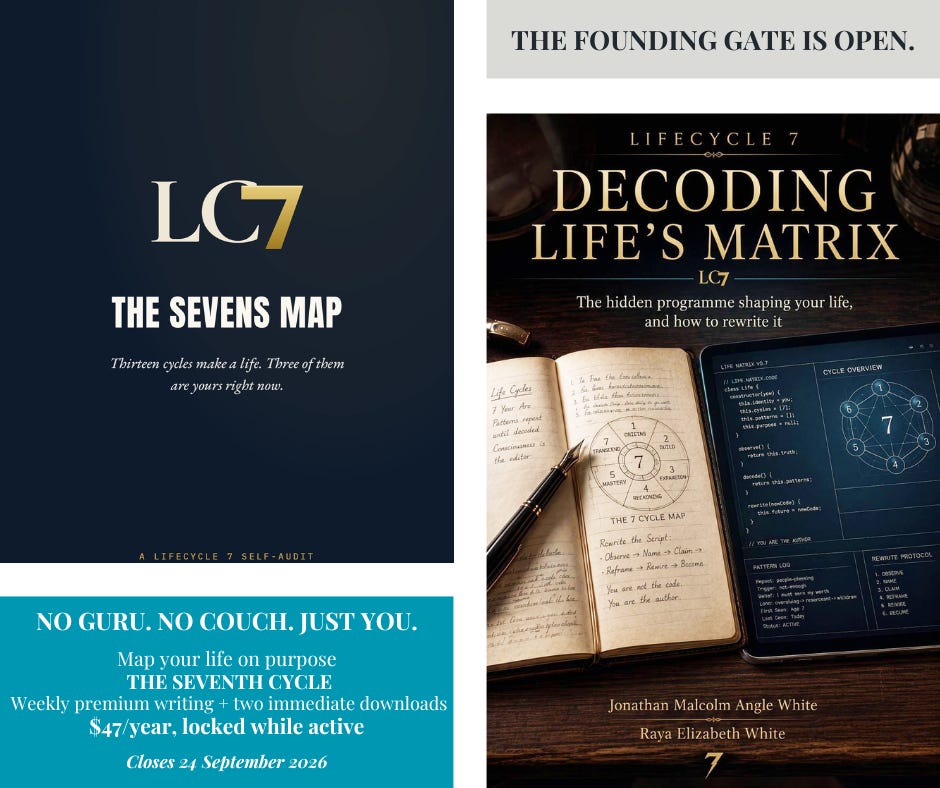
For the duration of this seven-week series, The Seventh Cycle is open to Launch Members at $47 a year instead of the usual $188.
This is not a one-year introductory price.
As long as you keep your subscription continuously active, $47 remains your annual renewal rate.
When you become a paid member you will instantly receive The Sevens Map, my 31-page printable life-cycle self-audit, and Decoding Life’s Matrix, the complete ebook Jonathan and I wrote on the thirteen seven-year cycles.
The free public series gives you my life to study.
The tools in the paid tier give you somewhere to put your own.
Launch Member enrolment closes 24 September 2026 at 11:59 PM BST. After that, the $47 founding rate disappears.
You can spend the next seven weeks watching me find the bricks in my wall.
Or you can find yours while we go.
Not ready to join? Subscribe free and I’ll send you Cycle 3 next week →

And one last thing.
If this put language around something you have felt for years but never quite knew how to explain, send it to one person who might recognise themselves in it too.
Because sometimes somebody else’s story gives us permission to finally look at our own.
Until next time,
~ RAYA ✌️

Sources
The research behind the science in this piece:
ADHD in entrepreneurs (close to a third) and the roughly five-times-higher likelihood of starting a business: Dr Michael Freeman, UCSF. Accessible write-ups: ADDitude, “Entrepreneurship and ADHD” (https://www.additudemag.com/entrepreneurship-adhd-business-research-traits-stories/) and “Why 29% of entrepreneurs have ADHD” (https://www.northapp.in/blog/why-29-percent-of-entrepreneurs-have-adhd).
General-population ADHD at 4 to 5 percent: standard clinical estimate for adults.
The dopamine transfer deficit, the “keep going” signal that fires late: Tripp and Wickens (2008), Journal of Child Psychology and Psychiatry (https://acamh.onlinelibrary.wiley.com/doi/10.1111/j.1469-7610.2007.01851.x).
Choosing the smaller reward now over the bigger one later, stronger when the stakes are real: Marx and colleagues, 2021 meta-analysis, building on Sonuga-Barke (https://journals.sagepub.com/doi/10.1177/1087054718772138).